
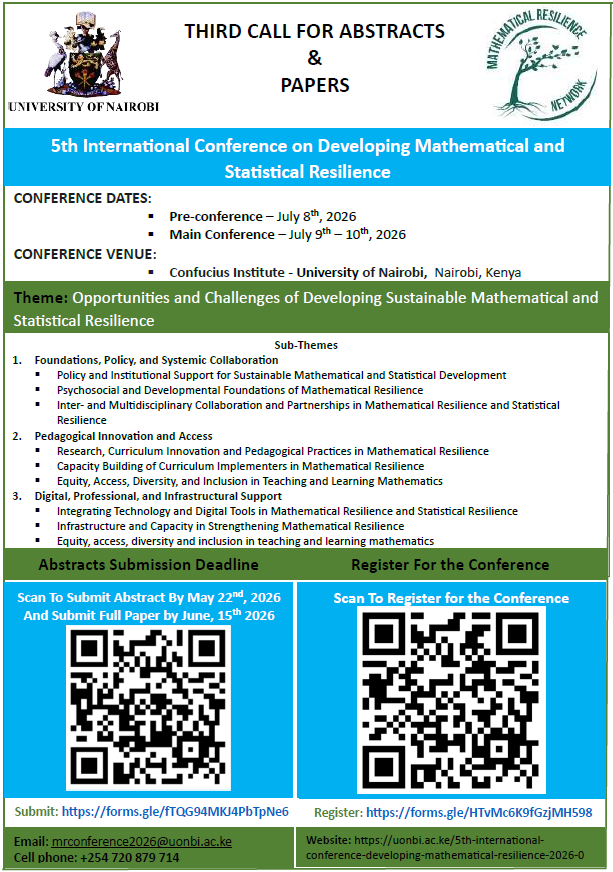
5th International Conference on Developing Mathematical Resilience 2026
5th International Conference on Developing Mathematical Resilience
Background
The Mathematical Resilience Network was launched in 2022 at the Third International Conference on Developing Mathematical Resilience with the intention of supporting academic and practitioner research and practice that uses the Mathematical Resilience Framework in addressing mathematics anxiety.
The University of Nairobi, through the Faculty of Education, will host the fifth International Conference on Developing Mathematical Resilience. The Conference will be held on July 8 -10, 2026. It will anchor on opportunities and challenges of developing sustainable mathematical and statistical resilience. The focus areas will be on policy, multidisciplinary collaboration and partnerships; research, curriculum innovation and pedagogical Practices; integrating technology and digital tools; equity, access, diversity and inclusion; and Institutional support for sustainable mathematical and statistical development
The conference will feature papers from researchers, academics, teachers and from those who work with people of any age who are learning mathematics. Having mathematical resilience enables people to overcome barriers that learning mathematics presents. Research papers will focus on overcoming mathematics anxiety, which is prevalent globally, and to help learners know how to protect their wellbeing and still learn mathematics. All the papers in this conference will be research-based to showcase how mathematical resilience is making an impact in learning environments from higher education to schools and in homes, in countries across the world.
Theme: Opportunities and Challenges of Developing Sustainable Mathematical and Statistical Resilience
Abstract Submission: https://docs.google.com/forms/d/e/1FAIpQLSdf6_F4CMnHkWuw-QFZFEpeh4tzXpyTPTrkm5yWGC9Q02BF-w/viewform
Register to attend the conference: https://researchweek.uonbi.ac.ke/index.php/the-5th-international-and-mathematical-conference-2026/
For donations towards the conference: https://researchweek.uonbi.ac.ke/index.php/donations-5th-international-conference-on-developing-mathematical-and-statistical-resilience-2026/
2. Sub-themes and focus areas
a) Foundations, Policy, and Systemic Collaboration
· Policy and Institutional Support for Sustainable Mathematical and Statistical Development
· Psychosocial and Developmental Foundations of Mathematical Resilience
· Inter- and Multidisciplinary Collaboration and Partnerships in Mathematical Resilience and Statistical Resilience
b) Pedagogical Innovation and Access
· Research, Curriculum Innovation and Pedagogical Practices in Mathematical Resilience
· Capacity Building of Curriculum Implementers in Mathematical Resilience
· Equity, Access, Diversity, and Inclusion in Teaching and Learning Mathematics
c) Digital, Professional, and Infrastructural Support
· Integrating Technology and Digital Tools in Mathematical Resilience and Statistical Resilience
· Infrastructure and Capacity in Strengthening Mathematical Resilience
· Equity, access, diversity and inclusion in teaching and learning mathematics
3. Venue – University of Nairobi Towers, UoN Main Campus, University Way Nairobi, Kenya
4. Dates for the conference – Pre-conference Workshop- 8th July 2026,
Conference – 9th and 10th July 2026
Send Abstract to: mrconference2026@uonbi.ac.ke
PAYMENT DETAILS
Registration Fees & Deadlines
A). Physical Attendance
• Early Registration (before 15 April 2026): $40
• Late Registration (before 15 June 2026): $45
• Students: $15
B). Virtual Attendance
• Early Registration (before 15 April 2026): $25
• Late Registration (before 15 June 2026): $30
• Students: $15
The Conference Code is: CONFED001
Payment Account
Account Name: University of Nairobi Grants Dollar
Account No.: 1104828960
Currency: US Dollars
Bank Name: KCB Bank
Branch :University Way,
Bank Address: P.O. Box 7206 –00100 GPO, Nairobi, Kenya
Bank Code: 036
Branch Code: 01167
Swift Code: KCBLKENX
The Payment will be made in form of direct bank transfer to the above account. Make sure you indicate under the payment reference/purpose the above code e.g Purpose : Payment for Conference charges : CONFED001
Register to submit Papers through this link
Register to attend the Conference through this LINK
KEYNOTE SPEAKERS
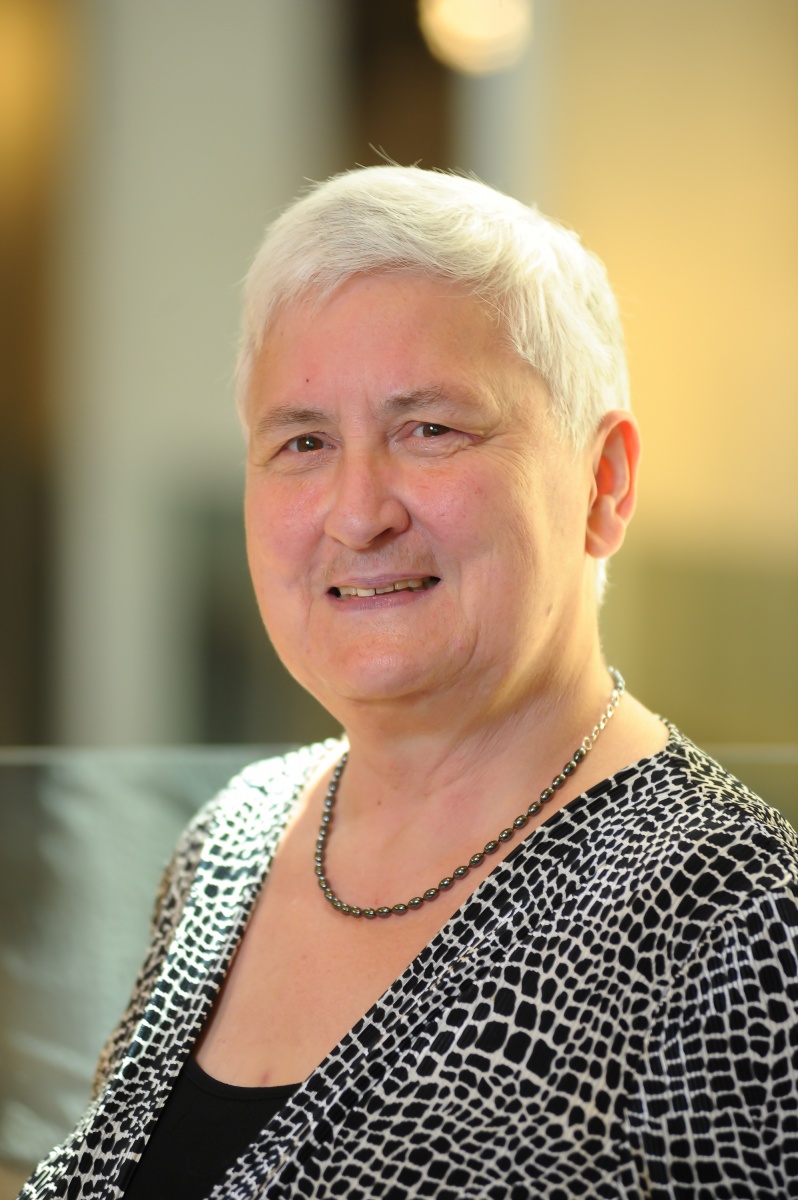
Sue Johnston-Wilder is an Associate Professor at the University of Warwick whose work focuses on developing mathematical resilience, fostering psychological safety, and protecting learners’ mathematical wellbeing. Co‑developer of the Mathematical Resilience Framework, she promotes supportive learning cultures where struggle is valued, learners feel safe to take risks, and maths anxiety can be addressed constructively. Sue collaborates internationally with educators and researchers to build environments that nurture agency, struggle, and positive mathematical identities. Through research, professional development, and advocacy, she champions inclusive practices that enable all learners to engage confidently with mathematics and to sustain mathematical wellbeing across diverse educational contexts.

Judah-Paul Makonye is an NRF-rated researcher and associate professor of mathematics education. He is the deputy chair for the Universities of South Africa, Teaching and Learning Mathematics Community of Practice. He obtained his PhD in 2012 at the University of Johannesburg. He taught at Zimbabwe and South African universities. Publishing widely, his research focuses on Mathematics Teacher Professional Knowledge, including Professional Noticing of Learner Mathematical Thinking. He has supervised tens of masters and PhD postgraduate students. In 2025, he was the steering committee chair for the African Chapter of the International Commission on Mathematical Instruction (AFRICME7) conference in South Africa.
 Dr. Gaye Williams, Honorary Senior Fellow, University of Melbourne, Victoria, Australia has taught mathematics and researched in senior and junior secondary school and elementary schools for over 30 years. Her collaborative problem-solving approach (Engaged to Learn) was found to increase affective and cognitive engagement and build resilience. Her PhD (undertaken within the International Learner’s Perspective Study lead by the late Professor David Clarke) investigated cognitive and affective elements of mathematics lessons and the role of autonomy and spontaneity in creative mathematical activity. It attracted the University of Melbourne’s Chancellor’s Prize 2007 and Australian Educational Researchers Association Doctoral Award 2006. Gaye has since studied the role of the relative resilience of group members in creative problem-solving activity, and effects of teacher resilience, or lack thereof, on implementing Engaged to Learn related problem-solving activity. The theoretical framing of these resilience building cultures includes anxiety reducing situations associated with Flow states.

Dr Carmo has a Ph.D. in Education from the Federal University of São Carlos (2002), and is a professor of the Department of Psychology at the Federal University of São Carlos (UFSCar).Coordinator at the Graduate Program in Psychology at UFSCar.
Researcher at the National Institute of Science and Technology on Behavior, Cognition and Teaching (INCT-ECCE).
Coordinates the Laboratory of Applied Studies to Learning and Cognition (LEAAC) of the Psychology Department at UFSCar. Coordinator of the Working Group on Psychology of Mathematics Education of the National Association for Research and Graduate Studies in Psychology (ANPEPP), Brazil.
 Harrison Njaru Mbogo is a dedicated educator and researcher with a passion for improving mathematics education. As a member of the National Council of Teachers of Mathematics and the British Educational Research Association, he's deeply invested in exploring the affective domain of learning – helping children thrive in maths classrooms. A scholar at Gonville & Caius College, University of Cambridge, Njaru's research focuses on tackling maths anxiety and fostering mathematical resilience.
 Prof. Christine N. Simiyu is an Associate Professor of Economics and the Dean of the School of Business at KCA University, Kenya. She holds an MA and PhD in Development Economics from the National Graduate Institute for Policy Studies (GRIPS), Tokyo, Japan, where she studied as a MEXT scholar, and an MSc in Mathematical Statistics from the University of Nairobi. She is an East Africa Social Science Translation (EASST) Fellow at the Center for Effective Global Action (CEGA), University of California, Berkeley, USA, and a member of Network for Impact Evaluation Researchers in Africa (NIERA).
Her work sits at the intersection of mathematical modelling, statistical methods, and impact evaluation, with a focus on entrepreneurship education, development finance, and evidence–based policy. She has led and collaborated on multi–country research projects applying quantitative and experimental methods to development challenges across Africa. She is currently leading research on generating evidence to inform and scale impact in youth-and women-led clean energy enterprises in Kenya, Uganda, Malawi, and South Africa, funded by IDRC in partnership with the African Centre of Technology Studies (ACTS) and the Kenya Climate Innovation Centre (KCIC).
https://sob.kcau.ac.ke/personnel/prof-christine-simiyu/
Accommodation
The University of Nairobi is surrounded by several hotels that are a walking distance to the institution.
ACCOMMODATION RATES FOR THE MR CONFERENCE
|
No. |
Hotel Name |
Item |
Costs per person |
Booking Link |
|
1. |
Nairobi Safari Club |
Bed & Breakfast
|
10,000/- per person on BB
|
|
|
Half- Board |
13,000/- on Half-board |
|
||
|
2. |
Golden Tulip |
Bed & Breakfast
|
125 USD
|
|
|
Half-Board |
155 USD |
|
||
|
3. |
Hotel Boulevard |
Bed & Breakfast |
7,500 per person |
|
|
Half-Board
|
10,000 per person |
|
||
|
4. |
United Kenya Club |
Bed & Breakfast |
5500 per person |
|
|
Half-Board |
6750 per person |
|
